Welcome to Healing Touch Clinic


Fistula Treatment in Noida
Many people in Noida live for months with a pimple-like opening near the anus that keeps oozing, assuming it is a boil that will eventually dry up. It rarely does. An anal fistula is a small tunnel under the skin that links the inside of the anal canal to the outside, and it seldom closes without proper treatment
At Healing Touch Clinic, Sector 132, Noida, patients can consult Dr.Tarun Mittal for evaluation and treatment of hernia conditions, including minimally invasive surgical options. Dr.Tarun Mittal is a laparoscopic surgeon with specialized training in minimal access surgery and dedicated hernia training.
If you live in Noida or elsewhere in NCR and have recurring discharge, pain or swelling around the anus, Healing Touch Clinic in Sector 132 offers focused care for exactly this problem. Dr. Tarun Mittal specialises in anorectal conditions and treats fistulas with techniques chosen to clear the infection while protecting your bowel control.
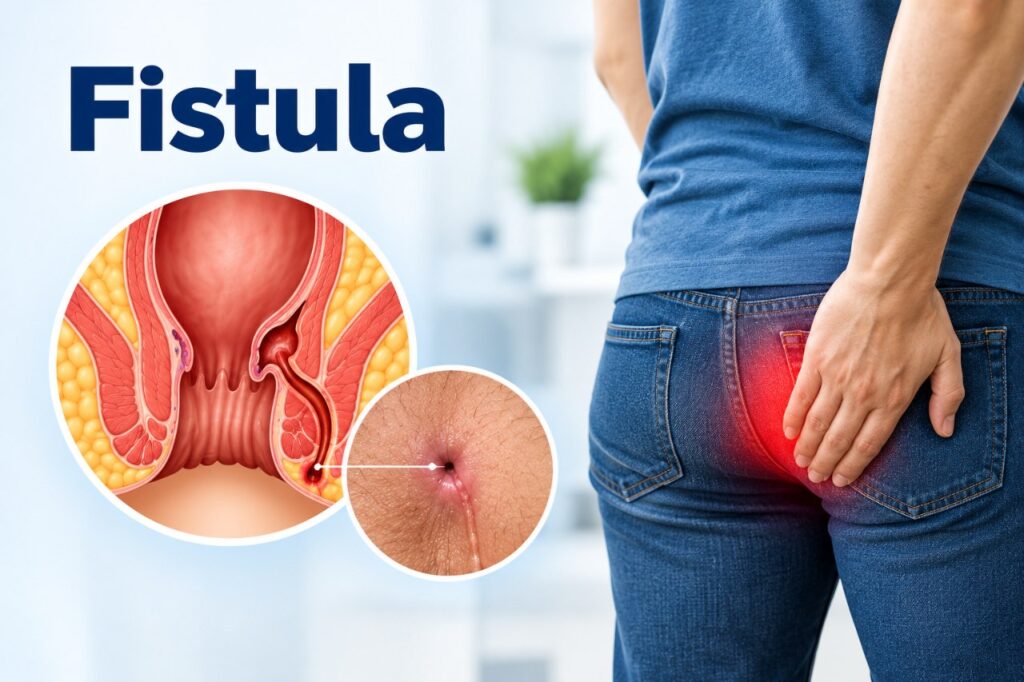
What Is an Anal Fistula?
An anal fistula is an abnormal channel between the anal canal and the skin around the anus. It usually begins when one of the small glands inside the anal canal becomes blocked and infected, forming an abscess. When the abscess bursts or is drained, a tract can remain behind. Fistulas are classified by how they pass through the sphincter muscles, as intersphincteric, transsphincteric, suprasphincteric or extrasphincteric. Low, simple tracts are easier to treat, while high or complex ones need careful planning.
What are the Symptoms?
- Repeated discharge of pus or blood-stained fluid near the anus
- Pain that is often worse when sitting or passing stool
- Swelling, redness or a tender lump beside the anus
- Itching and skin irritation
- Fever or chills when an abscess forms
- A small skin opening that closes and then reopens
Causes and Risk Factors
Most fistulas follow an anal abscess. Other contributors include Crohn’s disease, tuberculosis, earlier anal surgery or injury, diabetes and reduced immunity. Long-standing constipation or diarrhoea can add stress to the area. Rarely, a fistula is linked to a tumour, which is one reason a proper examination matters.
How a Fistula Is Diagnosed
The surgeon examines the area, looks for the external opening and feels along the tract. A proctoscopy may be done to look for the internal opening. For complex or recurrent cases, an MRI of the pelvis or an endoanal ultrasound shows the path of the tract and its relationship to the sphincter muscles. Sometimes the final assessment is made under anaesthesia. A colonoscopy may be added if Crohn’s disease is suspected. Accurate mapping is the key to preventing recurrence.
Treatment Options
Medicines alone cannot close a fistula. Antibiotics may settle an infection, but the tunnel remains, so surgery is the definitive treatment. The choice depends on where the tract lies, how many openings there are, any earlier surgery, your bowel control and any underlying disease.
- Fistulotomy: the tract is laid open so it can heal from the base. Suitable for low, simple fistulas.
- Seton placement: a soft thread is passed through the tract to drain infection and guide healing. Often used for high or complex fistulas, sometimes as a first stage.
- LIFT procedure: the tract is closed between the sphincter muscles without cutting them.
- Advancement flap: the internal opening is covered with healthy tissue from the rectal wall.
- VAAFT: a camera-guided technique described on its own page.
- Glue, plug or laser closure: options for selected cases.
Dr.Tarun Mittal’s official website lists advanced laparoscopic hernia repair among the procedures he performs. His professional background includes postdoctoral fellowship training in minimal access surgery and dedicated hernia training.
The appropriate surgical technique depends on the patient’s specific hernia and clinical circumstances.
Benefits of Timely Treatment
- Ends the cycle of discharge and repeated abscesses
- Protects the sphincter muscles when sphincter-saving techniques are used
- Reduces the chance of the tract becoming more complex
- Improves hygiene, comfort and daily confidence
Recovery and Aftercare
Many procedures are done as day care or with a short stay. Warm sitz baths, regular wound cleaning, a high-fibre diet, plenty of fluids and stool softeners help healing, which can take several weeks depending on the technique. Avoid straining and keep your follow-up visits. Report fever, rising pain, bleeding or fresh pus.
When to See a Specialist
See a surgeon if discharge continues for more than a few weeks after an abscess, or if you have had repeated boils near the anus.
What to Expect at Your First Visit
Your appointment starts with a private, unhurried conversation about how long the discharge has been present, any earlier abscesses and your bowel habits. The examination is brief and carried out with respect for your comfort. If imaging is needed, the surgeon will explain why, and you will leave knowing exactly what the next step is, whether that is a procedure, a scan or a period of watchful care.
Common Myths About Fistulas
- Myth: A fistula is only a boil that will dry up.
- Creams and tablets can cure it.
- Surgery always causes loss of bowel control.
- Only people with poor hygiene get fistulas.
- Fact: The tunnel stays beneath the skin and usually reopens.
- They may ease symptoms, but they cannot close a tract.
- The risk depends on the type of fistula, and sphincter-saving techniques exist for complex ones.
- They arise from blocked internal glands and can affect anyone.
FAQs
Can a fistula heal on its own?
Rarely. The tract may seem to close for a while, but it usually reopens.
Is fistula surgery painful?
The procedure is done under anaesthesia, and discomfort afterwards is managed with medicines and sitz baths.
Will it affect my bowel control?
The risk depends on how much sphincter muscle is involved. Sphincter-saving methods are chosen for complex fistulas, and your surgeon will explain the risks beforehand.
Can a fistula return?
It can, particularly with complex tracts or conditions such as Crohn’s disease. Careful mapping and follow-up lower the chance.
When can I return to work?
Many people resume desk work within a week or two, depending on the procedure.
Book a consultation with Dr. Tarun Mittal at Healing Touch Clinic, ATS Bouquet, Sector 132, Noida, or call +91 88516 32660.
Expert Surgical Care, Personalised for You
Get the right guidance and treatment advice from Dr. Tarun Mittal.
📞 Call Now: +91 88516 32660
Schedule Your Consultation Today or Call Now to Book Your Appointment!