Welcome to Healing Touch Clinic


VAAFT Treatment in Noida
VAAFT Treatment in Noida
Imagine treating a complex anal fistula without a large wound, without cutting through the muscles that keep you continent, and with a camera showing the surgeon exactly where the tunnel runs. That is the idea behind VAAFT, or video-assisted anal fistula treatment.
For residents of Noida and Delhi NCR who have been told their fistula is complex, recurrent or “high”, and who are worried about incontinence or months of dressings, it is worth knowing that this option exists. Healing Touch Clinic in Sector 132 specialises in modern anorectal procedures, and Dr. Tarun Mittal can assess whether VAAFT is the right fit for your fistula.
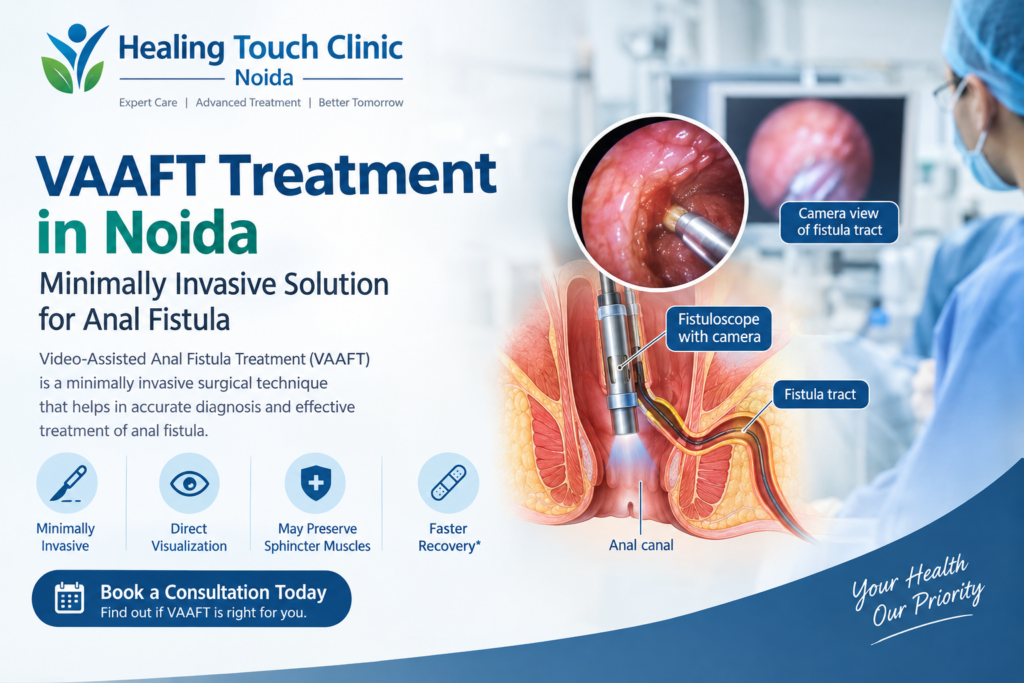
What Is VAAFT?
VAAFT is a minimally invasive, sphincter-saving technique developed in Italy in the mid-2000s. Instead of laying the whole tunnel open, the surgeon passes a thin rigid endoscope, called a fistuloscope, into the tract. The camera shows the inside of the fistula on a monitor, so the tract, its side branches and its internal opening can be seen directly rather than guessed at.
Who May Benefit?
VAAFT is mainly considered for fistulas that are difficult to treat by conventional cutting, such as:
- High transsphincteric fistulas that pass through a large amount of muscle
- Horseshoe fistulas and fistulas with several branches
- Recurrent fistulas after earlier surgery
- Patients who are anxious about losing bowel control
Very short, simple, superficial fistulas are often treated just as well, or better, with a straightforward fistulotomy.
Symptoms of a Fistula
- Persistent discharge of pus or blood near the anus
- Pain and swelling that flare up and settle repeatedly
- Skin irritation and itching around the opening
- Fever when an abscess forms
What are the Causes?
Most fistulas develop after an infected anal gland forms an abscess. Crohn’s disease, tuberculosis, earlier anal surgery and injury can also play a part. Treating the underlying disease matters as much as treating the tunnel itself.
Diagnosis
Your surgeon begins with an examination and a careful history. An MRI of the pelvis is often advised for complex or recurrent fistulas, because it maps the tract and its relationship to the sphincter. Any active abscess must be drained and settled first, since VAAFT works best on a tract that is not acutely infected.
How VAAFT Is Performed
- The procedure is done under spinal or general anaesthesia, so you feel no pain.
- The fistuloscope is introduced through the external opening. Fluid is run through it to open up the tract, and the surgeon follows the channel, noting any branches and locating the internal opening.
- Under direct vision, infected debris and diseased tissue inside the tract are removed with a small brush and forceps.
- Sealing the lining. The inner surface of the tract is treated with a fine electrode so that the diseased lining is destroyed from within.
- Closing the internal opening. The inner opening in the anal canal is closed with a stapler, stitches or a tissue flap, which stops the source of infection from feeding the tract.
Benefits of VAAFT
- No large open wound, so healing is generally smoother
- Sphincter muscles are preserved, lowering the risk of incontinence
- Hidden branches and the internal opening can be found accurately
- Less pain after the procedure compared with wide excision
- Day care or a short hospital stay in many cases
- Can be repeated, and does not rule out other techniques later.
Limitations to Understand
No technique suits every fistula. A fistula can persist or return after VAAFT, especially if the internal opening is not sealed well or an underlying disease such as Crohn’s is active. The result depends on selecting the right patient and on the surgeon’s experience with the equipment. Some patients need a second procedure. Your surgeon will talk through the realistic outcome for your particular fistula before you decide.
Recovery and Aftercare
Most patients go home the same day or the next day and return to light activity within a few days. Keep the area clean, take warm sitz baths, eat plenty of fibre and drink enough water so that stools stay soft. Mild discharge for a short time is normal as the tract settles. Attend every follow-up and report fever, severe pain or heavy bleeding promptly.
What to Expect on the Day of Surgery
You will be asked to fast beforehand and will meet the anaesthetist before the procedure. VAAFT usually takes less than a couple of hours, after which you are observed while you recover from the anaesthesia. Most patients are discharged the same day or the next morning with written instructions, medicines and a follow-up date.
Questions to Ask Your Surgeon Before VAAFT
- Is my type of fistula suitable for VAAFT?
- Where is the internal opening, and how will it be closed?
- What is the chance that I will need a second procedure?
- How will my bowel control be protected?
- How long should I stay off work, and what follow-up is needed?
FAQs
Is VAAFT painful?
The procedure itself is done under anaesthesia. Afterwards, there is usually mild to moderate discomfort that medicines control well.
Is VAAFT better than conventional fistula surgery?
It is not better for every fistula. For simple, low tracts, fistulotomy remains excellent. VAAFT is mainly valued for complex or recurrent tracts where protecting the sphincter is a priority.
Will I have visible scars?
The wounds are small, and there is no long cut along the tract.
Can the fistula come back?
It can. Careful selection, sealing of the internal opening and good follow-up reduce the risk.
How soon can I go back to work?
Many people return to desk work within a few days, depending on how they feel.
Book a consultation with Dr. Tarun Mittal at Healing Touch Clinic, ATS Bouquet, Sector 132, Noida, or call +91 88516 32660.
Expert Surgical Care, Personalised for You
Get the right guidance and treatment advice from Dr. Tarun Mittal.
📞 Call Now: +91 88516 32660
Schedule Your Consultation Today or Call Now to Book Your Appointment!